
It will become increasingly rare to hear me talk about reviews on this site, but I want to mention the few yet beautiful words that have been used, in different languages, to describe Bruma. A heartfelt thank you to Mirco Salvadori, Philippe Blanche, Vito Camarretta, François Bousquet and Peppe Trotta.
Mirco Salvadori, Rockerilla
Un canto immersivo che esplora il confine tra luce e oscurità, un viaggio sonoro di estrema dolcezza. Con un uso sapiente di elettronica minimale e materia ambient, Francis Gri crea atmosfere eteree che sembrano fluttuare tra il tangibile e l’intangibile. Ogni traccia è una ricerca di equilibrio, una danza di suoni che si sovrappongono, si dissolvono e si ricompongono in modo fluido. Musica come foschia che sfuma i contorni della realtà, ‘Bruma’ è un disco che affascina per la sua delicatezza e la sua capacità di evocare emozioni sottili al pari di un sogno che lentamente svanisce alle prime luci dell’alba. Un’esperienza sonora che rimane nell’anima, INTENSAMENTE LIEVE.
Vito Camarretta, Chain D.L.K: https://www.chaindlk.com/reviews/12710
Francis Gri composes like a dreamer who has never quite returned from sleep. His music lingers between wakefulness and slumber, unfolding like mist over frozen landscapes – each note a slow breath of condensation on a windowpane, each silence a space where memory curls in on itself.
With “Bruma”, Gri continues his exploration of delicate melodic textures and abstract soundscapes, weaving a sound world that is as fragile as it is immersive. This time, however, music alone does not tell the story. Included with the release is a short tale – one that gives “Bruma” an added weight, an aching, whispered narrative that mirrors the album’s slow, drifting movements.
“The story follows Bruma, a woman born without legs, who finds escape in dreamlike journeys to ethereal dimensions. But over time, the fire of imagination dims, and she becomes trapped in the barren world of reality – until, in her final days, she rediscovers a way back, dissolving into nature itself. Gri’s music is the soundtrack to this transformation, the passage from fleeting youth to disillusionment and, finally, to an acceptance that transcends both.
Musically, “Bruma” exists in a state of gentle suspension. Tracks like “Bruma I” and “Bruma III” stretch into vast, reverb-drenched spaces, where synth washes and distant echoes move like shifting fog. The album’s pacing is unhurried, inviting the listener to drift with it rather than chase after structure. “Bruma IV” carries a sense of weightlessness, while “Bruma VII” (the second one – because time is circular here) feels like the slow unraveling of a final thread, a long exhale into silence.
By choosing to work entirely with synthetic sounds rather than his usual field recordings, Gri crafts a world that feels detached from the physical, a realm of mirages and reverberations. The absence of found sound only heightens the sense of distance – this isn’t music tied to any one place, but rather to the shifting, unstable landscapes of memory.
At its core, “Bruma” is a meditation on impermanence. It is the moment before snow melts, the hush of a room before someone speaks, the space between reality and a dream. And when it ends, it leaves you not with closure, but with the feeling of having briefly touched something just beyond reach – before it slipped, softly, into the mist.
Philippe Blanche, Igloo Magazine: https://igloomag.com/reviews/francis-gri-bruma
Owner of the label Krysalisound and trained musician in nostalgic form of semi-classical ambient music Francis Grioffers us one outstanding collection of precious-diaphanous, blurred out dream-like pieces, as suggested by the title of the album. Without being demonstrative but with simple, organic, and efficient articulation between timbres, tone colors and textures, Francis Gri paints a whole musical universe where evocative stillness is displayed thanks to a vast array micro-sounds, concrete manipulations, spoken words, detached echoing piano notes, and languid drone guitar chords seconded by other instruments. What characterizes his style is a taste for orchestral music with roots in fictional scores, could be indie cinema or simply environmental-historical documentaries with a poetical aura.Sustained chords eerily fixated doubled by gritty noises and slumbering waves of electronics develop in an exquisite and soul-restoring balm. Glitch-esque altered piano sequences—as in the second piece “Bruma II”—will lead you in a lovely garden of broken or rusty layers engulfed in immemorial time. It’s difficult to pick up one favorite piece as these remain inwardly connected to each others. Pale timbres and intangible forms are harmoniously intertwined with touching melodies for a cloudy evanescent spiritual departure from our turbulent immediate reality.If you enjoy Japanese-Zen ambient skeches from Yoshimura but also fragile modern-classical piano by Adrian Lane, Mike Lazarev, Tristan Eckerson, and Ben Lukas Boysen, you will easily be seduced by the cosy and minimalist sound paintings of Francis Gri. Francis Gri is the kind of sound artist whose work deserves to be discovered by a wider audience of ambient enthusiasts, seekers of tranquility, and those drawn to introspective, quiet moments at home. Much like an old friend, Bruma‘s music offers comfort and solace, gently accompanying you through times of grief and personal reflection.
François Bousquet, EtherReal: http://www.etherreal.com/spip.php?article7032
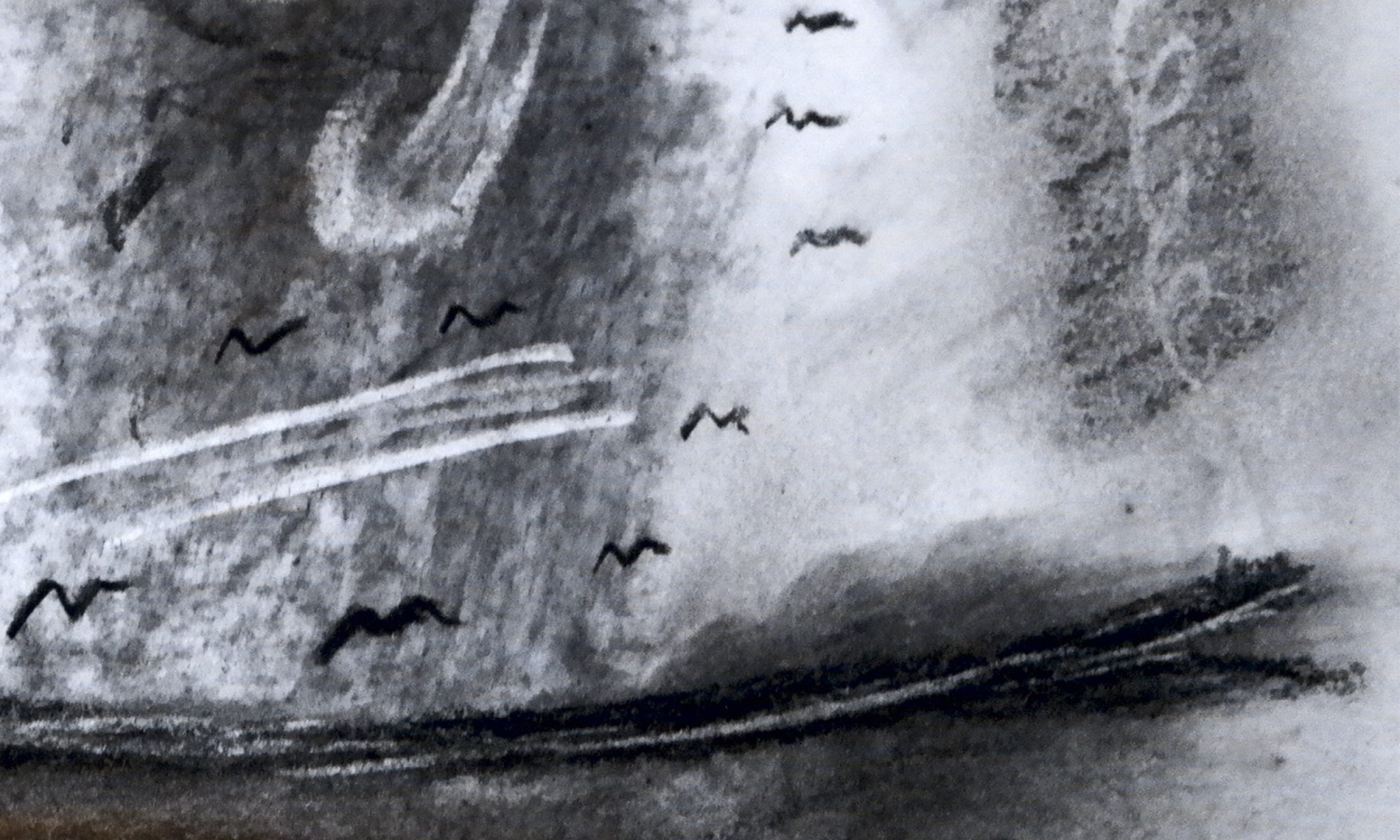
À l’instar de son précédent album (vieux d’à peine quatre mois), Francis Gri propose ce nouveau long-format de manière totalement autonome, via sa page Bandcamp, et dans un tirage très limité (35 exemplaires, en CDr). Sur le plan stylistique, l’ambient reprend, en revanche, le dessus, bien que le piano reste présent, mais se trouve, ici, accompagné par des traitements et petites crépitations. Parfaitement adaptés au visuel de pochette (ce ciel d’acier, parcouru d’oiseaux et d’une pluie battante), ces contributions sonores électroniques sont, en vérité, plutôt minoritaires face aux apports issus du clavier ou d’une guitare.Jouée sur les harmoniques ou par fondus en entrée (Bruma III), la six-cordes se fait aussi profonde que le clavier peut se montrer cotonneux, tous deux concourant à servir des compositions très réconfortantes, impeccables pour affronter la pluie figurée sur la pochette. Des cordes samplées et un mélodica (Bruma V), ou des petites notes façon glockenspiel ouaté (Bruma VI) sont aussi invités à soutenir des arpèges de guitare pour une tonalité proche du lo-fi. Quand c’est au tour du piano de se trouver au premier plan, dans une veine plus directe, l’Italien s’oriente vers une forme plus néo-classique et moins ambient, à nouveau agrémentée, néanmoins, de petits effets et incursions électroniques (Bruma IV).Extrêmement délicat, Bruma est également construit pour conduire l’auditeur à sa dernière piste, longue de dix minutes, et qui synthétise le propos, avec ses traits de guitare, ses déliés de clavier et ses petites notes perlées, le tout posé sur des textures travaillées (Bruma VII). Belle conclusion d’un disque d’un long-format soyeux et gracile, ce morceau donne immédiatement envie de s’y replonger, indice toujours caractéristique d’un enthousiasme certain.
Peppe Trotta, SoWhat: https://sowhatmusica.wordpress.com/page/2/
Una storia a parole, ma anche e soprattutto un racconto sonoro. Bruma è un itinerario dalla forma duplice, una visione nella quale Francis Gri connette due mezzi espressivi di grande forza. Il testo è un’elegia dolente, una fiaba crepuscolare che ci ricorda quanto sia importante sognare e non arrendersi. La musica ne sottolinea lo sviluppo servendosi di quella perizia ambient ampiamente messa in mostra nel corso di una carriera ormai lunga.
Il flusso è vaporoso, incline all’onirico come spesso accade nelle proposte del musicista italo-svizzero. Modulazioni diafane intrecciate a materia granulosa in un insieme organico dalla consistenza tattile (Bruma I), scandito da stille di melodia sintetica a definire paesaggi affini all’universo 12k (Bruma II) e da fraseggi strumentali aggraziati di piano e chitarra (Bruma IV).
A tornare è l’atmosfera onirica di While, lavoro che ha dato inizio ad un nuovo corso dopo la chiusura dell’avventura Krysalisound, qui improntata ad un maggiore lirismo che segue in modo stretto l’evoluzione dello scritto di cui il disco è commento sonoro. In ciascun capitolo domina un senso della misura, un equilibrio virtuoso che consente ad ogni risonanza di riverberare fino a trovare completezza tra danze luminose (Bruma VI) e piani sequenza costellati da echi ambientali (Bruma VII) inclini a disegnare orizzonti di malinconia “accettando ogni stagione come una carezza dell’universo.”
 francis gri